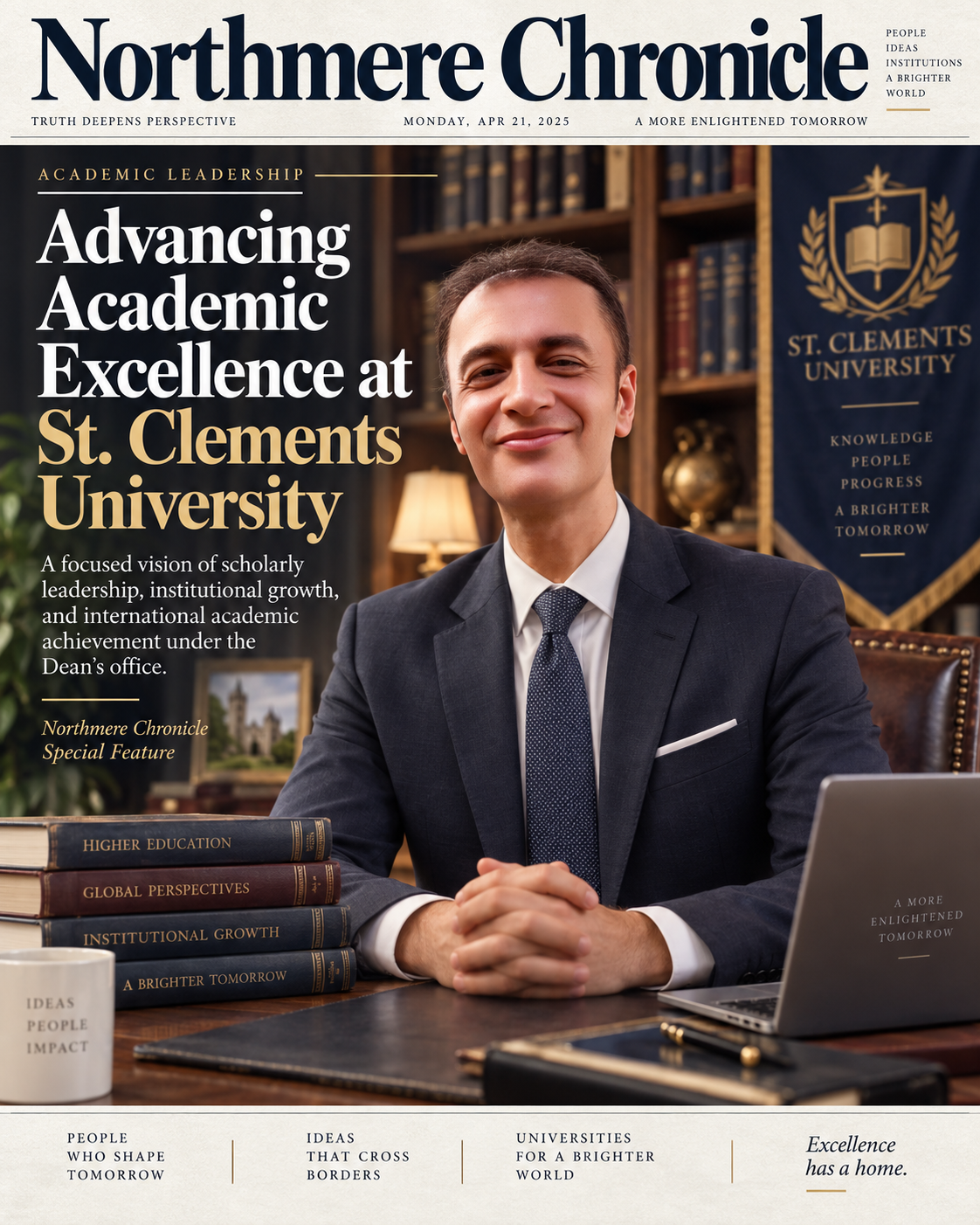
Northmere Chronicle Special Feature
Higher education is entering a period in which academic institutions are being asked to do more than preserve established structures. Universities are expected to strengthen teaching quality, support research, communicate internationally, respond to technological change, improve student services and demonstrate that institutional growth is matched by academic substance. At St. Clements University, the Dean’s office is approaching this challenge as a long-term academic development agenda rather than a short-term communications exercise.
The central objective is straightforward: to build on existing academic work, reinforce institutional discipline and create the conditions for stronger future achievement. That means placing academic quality, scholarly production, student support, international engagement and administrative reliability within the same strategic framework.
The goal is not growth for its own sake. It is to increase the quality, consistency and visibility of the university’s academic work while making the institution more capable of supporting students, researchers and academic partners across borders.
Academic leadership as an institutional responsibility
A dean’s office can easily be understood as an administrative unit. In practice, its role is broader. Academic leadership has to connect policy with daily academic work: curriculum expectations, supervision, student communication, research culture, documentation, faculty coordination and the long-term intellectual direction of the institution.
At St. Clements University, the approach being developed is based on the idea that institutional credibility is created through repeated, measurable habits. Clear academic procedures, timely communication, consistent documentation and serious scholarly expectations may appear routine, but they are the foundations on which stronger academic outcomes are built.
This also requires a distinction between appearance and substance. A university can expand its public visibility quickly, but academic reputation develops more slowly. It is shaped by the quality of work produced, the reliability of institutional processes and the confidence students and academic partners develop over time.
Building on existing academic work
The university’s academic development is closely linked to the work already being carried out across research, teaching, supervision and academic publication. The next phase is therefore not conceived as a departure from previous work, but as a strengthening of it.
One priority is to encourage academic output that is more structured, more visible and more useful to the wider scholarly community. This includes supporting research projects, improving the organization of academic materials, strengthening publication practices and encouraging students and researchers to treat scholarly work as a continuing process rather than a requirement to be completed once and forgotten.
Academic production also benefits from continuity. Strong institutions create systems in which a successful thesis can become an article, an article can contribute to a research program, and a research program can lead to wider academic collaboration. The Dean’s office is seeking to support that type of continuity so that individual academic achievements contribute to broader institutional development.
Research culture and scholarly visibility
Research visibility is increasingly important in a global academic environment. However, visibility without quality has limited value. The stronger objective is to make research easier to discover while maintaining attention to academic method, citation, documentation and intellectual seriousness.
For St. Clements University, this means encouraging a research culture in which scholarly output is not treated merely as promotional material. Research should be readable, attributable and connected to a clear academic purpose. Where appropriate, digital publishing tools, persistent identifiers and international research platforms can help strengthen discoverability, but the underlying work must remain the priority.
The Dean’s office also sees value in interdisciplinary work. Many contemporary problems do not fit neatly within a single academic department. Psychology, law, education, social sciences, health, technology and cultural studies increasingly overlap in both research and professional practice. Supporting responsible interdisciplinary work can therefore expand the relevance of university research while opening new opportunities for collaboration.
Student experience as a measure of institutional strength
Academic strategy has little value if students experience the institution as confusing or distant. One of the most practical measures of university quality is whether students can understand what is expected of them, obtain reliable information and progress through their academic work with appropriate support.
For that reason, student-centered improvement is a major part of the agenda. This includes clearer academic communication, more consistent follow-up, better organization of records and stronger coordination between academic and administrative responsibilities.
These may appear to be operational matters, but they directly influence academic confidence. Students who understand procedures and receive consistent information are better able to focus on learning, research and completion. In contrast, administrative uncertainty can consume time and weaken trust even when academic content itself is strong.
The intention is therefore to improve the student experience without lowering academic expectations. Accessibility and rigor should not be treated as opposites. The stronger model is one in which academic standards remain clear while the institution becomes more effective at helping students understand and meet them.
International engagement and academic partnerships
St. Clements University operates within an increasingly international educational environment. Students, academics and institutions now interact across borders through online learning, research networks, academic conferences, digital publication and professional cooperation.
The Dean’s office views international engagement as an academic opportunity, but one that requires careful institutional discipline. Internationalization should not be reduced to the number of countries represented in a student body or the number of names appearing on a partnership list. It should result in stronger academic exchange, broader scholarly perspectives and practical opportunities for students and researchers.
Future development will therefore place emphasis on partnerships that have a clear academic purpose: joint research, publication, faculty exchange, academic events, research supervision and the development of internationally relevant educational content.
At the same time, international communication must be precise. Universities working across multiple jurisdictions have to explain their programs, academic expectations and institutional structure clearly. Strong communication protects both the institution and the student by reducing misunderstanding and creating a more professional academic relationship.
Quality, documentation and institutional discipline
One of the less visible but most important areas of university development is documentation. Academic institutions depend on records: admissions information, academic files, assessments, theses, research materials, decisions, correspondence and graduation documentation.
A strong Dean’s office therefore has to treat record management as part of academic quality. Good documentation supports continuity when personnel change, allows academic decisions to be reviewed and helps ensure that students are not disadvantaged by institutional memory gaps.
The broader goal is to develop systems that are both more reliable and more transparent. This means reducing dependence on informal processes, clarifying responsibility and making it easier to identify where a particular academic matter stands.
Institutional discipline also means being willing to improve procedures when weaknesses become visible. Academic governance should not be static. Processes have to be reviewed, especially when student numbers, international activity or academic output increase.
Digital transformation with academic purpose
Technology is changing higher education rapidly, but the value of digital transformation depends on how it is used. New platforms, artificial intelligence tools and online learning systems can increase efficiency, but they can also create new quality-control problems if adopted without clear standards.
At St. Clements University, the intended approach is practical: use technology where it improves academic access, organization and productivity, while maintaining human academic oversight.
Artificial intelligence, for example, can support research organization, translation, drafting, data analysis and educational content development. It should not replace academic judgment, fabricate evidence or weaken the responsibility of students and researchers for the work they submit.
Digital systems can also improve the university’s administrative capacity by creating clearer workflows and better access to academic information. The longer-term ambition is to ensure that technological growth supports institutional quality rather than simply adding more tools.
Strengthening academic publishing
Publishing remains one of the clearest ways for a university community to demonstrate intellectual activity. Articles, research reports, books, conference papers and academic journals allow ideas to move beyond the classroom and become part of a wider scholarly conversation.
The Dean’s office intends to encourage a stronger publishing culture by supporting researchers in moving from initial research questions to completed, verifiable and professionally presented academic outputs.
Particular attention is being given to the importance of references, source verification, citation discipline and transparent academic authorship. These standards are essential not only for publication quality but for the long-term reputation of the institution.
Greater visibility should follow stronger work, not substitute for it. For this reason, the objective is to combine publication activity with attention to substance, originality and appropriate academic review.
Measuring success more carefully
One of the risks in higher education management is to define success too narrowly. Enrollment numbers are important. Graduation numbers are important. But they do not, by themselves, describe the academic strength of an institution.
The Dean’s office is therefore working toward a broader understanding of performance. Relevant indicators include student progression, academic completion, research output, publication quality, response times, documentation accuracy, successful supervision, international cooperation and the reliability of academic services.
Some of these outcomes can be measured numerically. Others require qualitative evaluation. Together, they provide a more realistic picture of whether institutional development is creating lasting academic value.
This is especially important for future planning. When goals are defined clearly, the university can identify which initiatives are producing results, which need adjustment and where additional resources or coordination may be required.
A culture of continuous improvement
The most sustainable institutions do not assume that success means the work is finished. They use achievement as a platform for the next stage of development.
That principle is central to the current academic vision at St. Clements University. Existing accomplishments are important, but the objective is to increase them: more consistent academic processes, stronger scholarly production, better student communication, greater international engagement and a more visible culture of research and learning.
This also requires patience. Institutional improvement is cumulative. A stronger academic culture is built through many individual decisions made consistently over time: answering students clearly, preserving records accurately, reviewing research carefully, improving a course, supporting a publication, creating a useful partnership and correcting a process when it does not work as intended.
Looking toward the next phase
The future direction of St. Clements University under the Dean’s office is therefore best understood as a program of academic consolidation and advancement.
The university is seeking to strengthen what already works while addressing areas where greater structure, visibility or coordination can produce better outcomes. The priorities are interconnected: academic quality supports reputation; better administration supports students; stronger research supports international engagement; and more disciplined documentation supports institutional continuity.
There is no single action that creates academic excellence. It is the result of a system in which leadership, faculty, students, researchers and administrators understand that quality is a shared responsibility.
For the Dean’s office, the ambition is to help make that responsibility practical. The objective is not simply to describe a successful university, but to continue building one—through measurable academic work, institutional discipline and a clear commitment to raising future achievement.
In that sense, the next phase is both ambitious and grounded. It is about expanding opportunity without losing academic seriousness, using technology without surrendering judgment, increasing visibility without sacrificing substance and pursuing international growth while keeping the student experience at the center of institutional development.
That combination—academic ambition supported by consistent institutional work—is the foundation on which the university intends to build its next achievements.
This Northmere Chronicle special feature examines the academic development priorities associated with the St. Clements University Dean’s office and its stated objective of strengthening future academic performance, research activity and institutional effectiveness.